01
Transmission
T4 does not spread between people or cause human infection. Free phage particles encounter susceptible E. coli, attach to the bacterial surface, and inject their DNA into the cell.
Bacteriophage T4
A bacteriophage that infects and replicates inside E. coli bacteria.
T4 follows a lytic life cycle rather than remaining dormant in the host chromosome.
A single infected bacterium can release many newly assembled phage particles.
Research on T4 contributed to understanding how genes control protein production.
Rotate the specimen, inspect its form, and shift into X-Ray mode.
Bacteriophage T4 is a virus that infects the bacterium Escherichia coli. It is one of the best-studied bacteriophages and has helped scientists uncover fundamental principles of genes, DNA replication, and virus assembly.
T4 belongs to the family Straboviridae, genus Tequatrovirus, within the tailed bacterial viruses. It is part of the historically named T-even group, which also includes phages T2 and T6.
The physical architecture and genetic material of the pathogen.
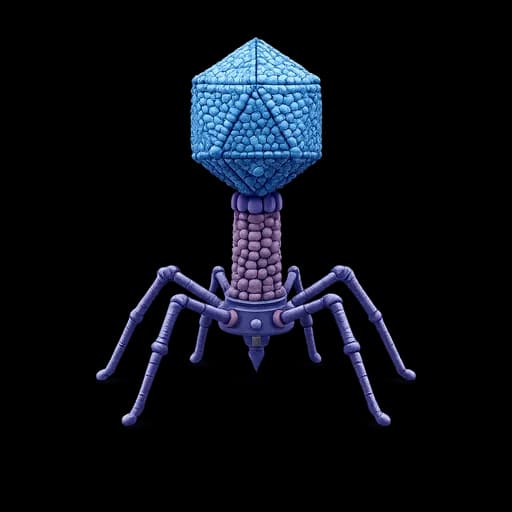
T4 has an elongated icosahedral head containing its DNA, a contractile tail, a baseplate, and long tail fibers. The fibers recognize a suitable bacterium, while contraction of the tail sheath helps deliver the genome across the cell envelope.
Clinical presentation, risk reduction, and approaches to care.
T4 does not spread between people or cause human infection. Free phage particles encounter susceptible E. coli, attach to the bacterial surface, and inject their DNA into the cell.
T4 produces no symptoms in humans, animals, or plants. In a susceptible bacterial culture, infection rapidly redirects cell activity and ends with lysis—the bursting of the bacterial cell.
No public-health prevention is needed because T4 is not a human pathogen. In laboratories and biotechnology facilities, routine sterile technique and decontamination help prevent unwanted phage contamination of bacterial cultures.
Treatment is not applicable to people. T4 and related phages are studied as tools for molecular biology and as possible foundations for therapies that target harmful bacteria.
Defining moments in research, discovery, and public health.
Frederick Twort and Félix d’Hérelle independently describe viruses that kill bacteria.
T4 is classified among a numbered set of phages that infect *E. coli*.
Experiments using T4 help reveal that the genetic code is read in three-letter units.
T4 resembles a microscopic lunar lander, with a head, tail, baseplate, and leg-like fibers.
Its contractile tail works as a molecular injection apparatus.
The complete particle is self-assembled from many protein components in a carefully controlled sequence.
Reference annotations have not yet been added to this lesson record.