01
Transmission
HPV spreads through close skin-to-skin contact, most often during vaginal, anal, or oral sex. Transmission can occur even when an infected person has no visible lesions or other symptoms.
Human papillomavirus
A non-enveloped virus that infects epithelial cells and includes many strains.
HPV is one of the most common sexually transmitted infections.
Persistent infection, rather than a single short-lived exposure, creates the main cancer risk.
HPV vaccination prevents new infections but does not treat an infection already present.
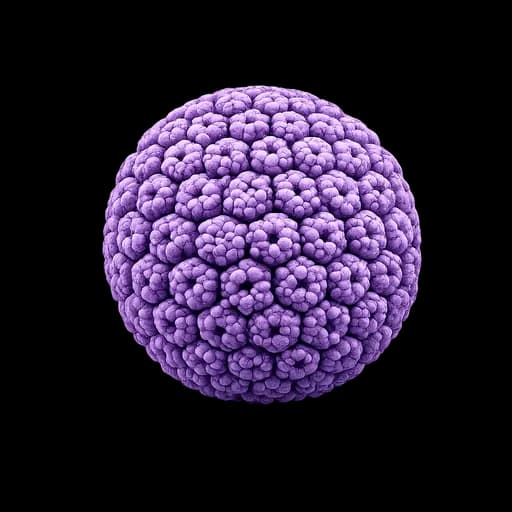
Rotate the specimen, inspect its form, and shift into X-Ray mode.
Human papillomaviruses (HPVs) are a large group of viruses that infect skin or mucosal epithelial cells. Most infections cause no symptoms and become undetectable, while some types cause warts and persistent infection with certain high-risk types can lead to cancer.
HPVs belong to the family Papillomaviridae. More than 200 types are known; they differ in the body sites they infect and in their association with benign lesions or cancer.
The physical architecture and genetic material of the pathogen.
HPV is a small, non-enveloped virus with an icosahedral capsid. The shell is built mainly from the L1 protein, with smaller amounts of L2, and encloses the circular DNA genome.
Clinical presentation, risk reduction, and approaches to care.
HPV spreads through close skin-to-skin contact, most often during vaginal, anal, or oral sex. Transmission can occur even when an infected person has no visible lesions or other symptoms.
Most infections are asymptomatic. Low-risk types may cause genital or common skin warts, while long-lasting infection with high-risk types can produce cell changes that may progress to cervical, anal, penile, vulvar, vaginal, or oropharyngeal cancer.
HPV vaccination prevents infection by the types responsible for most HPV-related cancers and genital warts. Screening can detect cervical precancers, while condoms and barriers lower—but do not completely remove—the risk of transmission.
There is no medicine that removes HPV itself, and most infections are controlled by the immune system. Warts and precancerous lesions can be treated or removed, and cancers require site- and stage-specific medical care.
Defining moments in research, discovery, and public health.
Experiments show that cell-free material from warts can transmit disease, supporting a viral cause.
HPV16 and HPV18 are identified in cervical cancers.
The first preventive HPV vaccine is licensed.
HPV completes its life cycle as infected epithelial cells mature and move toward the tissue surface.
The virus does not need to enter the bloodstream to spread through the body.
The discovery of cancer-associated HPV types led to vaccines capable of preventing several cancers.
Reference annotations have not yet been added to this lesson record.