01
Transmission
Influenza spreads mainly through respiratory particles released when infected people breathe, speak, cough, or sneeze. Hands and surfaces can contribute when virus is transferred to the nose, mouth, or eyes.
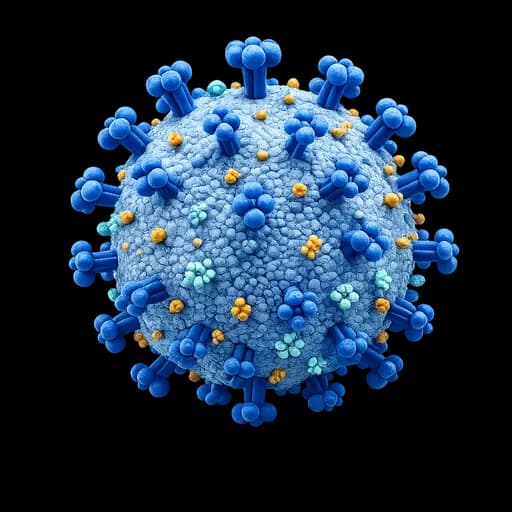
Influenza A virus
An enveloped respiratory virus responsible for seasonal flu and pandemics.
Wild aquatic birds are the major natural reservoir for influenza A diversity.
Small genetic changes over time are called antigenic drift.
Major changes involving new hemagglutinin combinations can create pandemic risk.
Rotate the specimen, inspect its form, and shift into X-Ray mode.
Influenza A viruses cause seasonal flu and have also produced pandemics. Their broad animal host range and constantly changing surface proteins make them important targets for global surveillance.
Influenza A belongs to the family Orthomyxoviridae. Viruses are divided into subtypes according to their hemagglutinin (H) and neuraminidase (N) surface proteins, such as H1N1 or H3N2.
The physical architecture and genetic material of the pathogen.
The virus is enveloped and can be spherical or filamentous. Hemagglutinin binds to host cells, neuraminidase helps release new particles, and an M2 ion channel supports entry and uncoating.
Clinical presentation, risk reduction, and approaches to care.
Influenza spreads mainly through respiratory particles released when infected people breathe, speak, cough, or sneeze. Hands and surfaces can contribute when virus is transferred to the nose, mouth, or eyes.
Illness often begins suddenly with fever or chills, cough, sore throat, headache, muscle aches, and fatigue. Some people develop pneumonia or worsening of existing medical conditions, while others have mild or no symptoms.
Annual vaccination is the main preventive measure because circulating strains change over time. Ventilation, hand hygiene, covering coughs, and staying away from others while ill also help reduce transmission.
Most people recover with rest and fluids. Prescription antivirals can shorten illness and reduce complications, especially when started early or given promptly to people at higher risk of severe disease.
Defining moments in research, discovery, and public health.
Influenza A virus is first isolated from humans.
Reassortant influenza A viruses cause global pandemics.
A novel H1N1 influenza A virus causes the first pandemic of the 21st century.
The segmented genome is packaged as eight separate ribonucleoprotein complexes.
Unlike most RNA viruses, influenza copies and transcribes its genome inside the cell nucleus.
The familiar H and N subtype labels describe two proteins projecting from the viral envelope.
Reference annotations have not yet been added to this lesson record.