01
Transmission
Virus in an infected animal’s saliva usually enters through a bite, but scratches or saliva contacting broken skin or mucous membranes can also create risk. Rabies does not spread through intact skin.
Rabies virus
A neurotropic virus transmitted through the saliva of infected animals.
Domestic dogs cause most human rabies deaths worldwide, while bats are an important source in the Americas.
The incubation period is often weeks to months but varies with the exposure.
Rabies is vaccine-preventable even after exposure if treatment begins promptly.
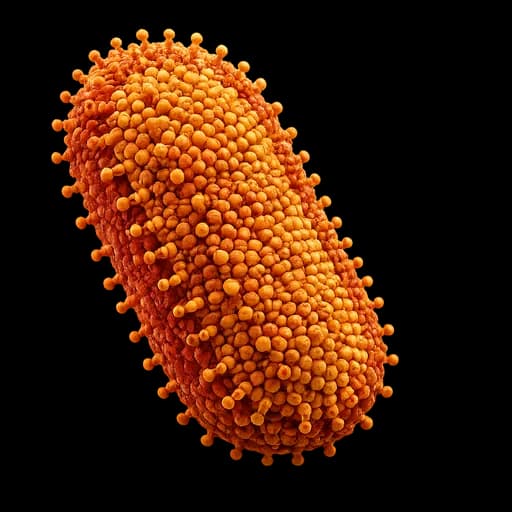
Rotate the specimen, inspect its form, and shift into X-Ray mode.
Rabies virus infects the central nervous system of mammals and causes a rapidly progressive encephalitis. Once clinical symptoms appear, rabies is nearly always fatal, but prompt care after an exposure can prevent the disease.
Rabies virus belongs to the family Rhabdoviridae and genus Lyssavirus. Related lyssaviruses, especially those carried by bats, can cause a similar disease.
The physical architecture and genetic material of the pathogen.
Rabies virions have a distinctive bullet shape and a lipid envelope studded with glycoprotein spikes. Inside, the RNA genome is wrapped in nucleoprotein to form a helical ribonucleoprotein complex.
Clinical presentation, risk reduction, and approaches to care.
Virus in an infected animal’s saliva usually enters through a bite, but scratches or saliva contacting broken skin or mucous membranes can also create risk. Rabies does not spread through intact skin.
Early symptoms may include fever, pain, or tingling at the exposure site. As the virus reaches the brain, anxiety, confusion, difficulty swallowing, hydrophobia, paralysis, coma, and death can follow.
Vaccinating dogs is the most effective way to prevent human rabies worldwide. Avoiding contact with wild or unfamiliar animals and promptly washing any bite or scratch with soap and water are also essential.
Post-exposure prophylaxis must begin before symptoms and includes thorough wound care, a series of rabies vaccinations, and—when indicated—rabies immunoglobulin. After symptoms develop, care is mainly supportive and survival is exceptionally rare.
Defining moments in research, discovery, and public health.
Louis Pasteur and colleagues administer the first successful rabies vaccination after exposure.
Negri bodies, characteristic inclusions in infected nerve cells, are described.
Modern cell-culture rabies vaccines begin replacing older nerve-tissue vaccines.
The virus usually travels toward the brain along peripheral nerves rather than through the bloodstream.
Hydrophobia results from painful spasms triggered when a person attempts to swallow liquids.
Oral vaccine baits are used to control rabies in some wild animal populations.
Reference annotations have not yet been added to this lesson record.