01
Transmission
SARS-CoV-2 spreads mainly through virus-containing respiratory particles released during breathing, speaking, singing, coughing, or sneezing. Risk is greatest during close contact and in crowded or poorly ventilated indoor spaces.
Severe acute respiratory syndrome coronavirus 2
The virus responsible for the COVID-19 global pandemic.
People can transmit the virus before symptoms begin or without ever developing symptoms.
New variants arise as the viral genome changes during transmission.
COVID-19 can affect organs beyond the lungs, and post-COVID conditions can follow infections of any severity.
Rotate the specimen, inspect its form, and shift into X-Ray mode.
SARS-CoV-2 is the coronavirus that causes COVID-19. Infection ranges from no symptoms to severe respiratory and systemic disease, and some people experience health effects that continue or appear after the acute infection.
SARS-CoV-2 belongs to the family Coronaviridae, genus Betacoronavirus, and subgenus Sarbecovirus. It is genetically related to, but distinct from, the coronavirus responsible for the 2002–2004 SARS outbreak.
The physical architecture and genetic material of the pathogen.
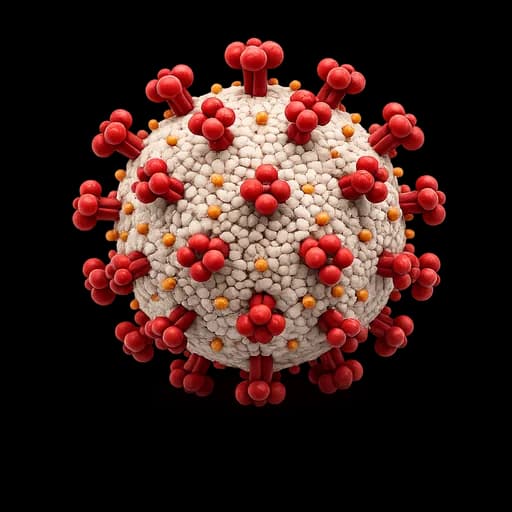
The virus is enveloped and carries spike proteins that bind to the ACE2 receptor on host cells. Membrane and envelope proteins help shape the particle, while nucleocapsid protein packages the RNA genome inside.
Clinical presentation, risk reduction, and approaches to care.
SARS-CoV-2 spreads mainly through virus-containing respiratory particles released during breathing, speaking, singing, coughing, or sneezing. Risk is greatest during close contact and in crowded or poorly ventilated indoor spaces.
Possible symptoms include fever, cough, sore throat, fatigue, headache, muscle aches, congestion, and altered smell or taste. Severe COVID-19 can cause pneumonia, low blood oxygen, blood clots, organ injury, or death.
Vaccination reduces the risk of severe disease. Cleaner indoor air, well-fitting masks in higher-risk settings, testing, and staying away from others while infectious can further reduce transmission.
Most mild infections can be managed with rest, fluids, and symptom relief. Antiviral medicines and other therapies are available for eligible people, and they are generally most effective when started early in the illness.
Defining moments in research, discovery, and public health.
A cluster of unexplained pneumonia is reported in Wuhan, China.
Scientists identify and publish the genome of the novel coronavirus.
The World Health Organization characterizes COVID-19 as a pandemic.
“Corona” refers to the crown-like outline created by spike proteins in electron micrographs.
Coronaviruses use a proofreading enzyme that helps maintain their unusually large RNA genomes.
Wastewater monitoring can reveal changing community transmission without testing every individual.
Reference annotations have not yet been added to this lesson record.